

Categories
Cybersecurity

Fall Into Cyber Awareness: Preparing for the Surge of Scams and Social Engineering

Fall is here. The leaves are changing, Halloween decorations are appearing in yards, pumpkin spice is showing up in everything imaginable, and somewhere, some misguided person is probably trying to replace perfectly good buffalo wing sauce with pumpkin spice wing sauce. Sadly, it is also the time of year when scams and social engineering attacks start taking advantage of the season.

October is Cybersecurity Awareness Month, which makes this a great opportunity to talk about the threats we face and, more importantly, what we can do about them. While cybersecurity is something we should be thinking about all year, the changing seasons, holidays, shopping events, and charitable giving provide attackers with plenty of opportunities to make their scams seem timely and believable, and believable is exactly what they need.

Scammers Follow the Calendar Too

Cybercriminals understand something that marketers have known for years: timing matters. A phishing email about a package delivery is much more believable when people are doing a lot of online shopping. A fake charity request can be more effective when people are already thinking about giving. A message about an employee benefits change may get more attention during open enrollment. The truth is, the basic scam may not be new at all, the attackers simply change the wrapper to fit the mood.

This is one of the reasons social engineering continues to work. Attackers do not necessarily need to find some highly technical way to defeat a security system when they can convince someone with legitimate access to do the work for them. They may send a phishing email designed to steal credentials, impersonate an executive asking for an urgent payment, create a fake shopping site offering a deal that is just a little too good to be true, or pose as a charity asking for donations. Nothing is off the board, or out of bounds when it comes to lining their pockets. In each of these cases, like most any social engineering attack, the attacker is simply trying to get the victim to act before they stop and think about what is happening.

Why Seasonal Scams Work

Social engineering attacks often rely on emotion. Urgency, fear, curiosity, excitement and even generosity can influence how we make decisions. During the fall and heading into the holiday season, there are plenty of opportunities to trigger those emotions.

An unbelievable deal on something you have been looking for, or is in short supply during the holiday season, can generate excitement. A notice that an account is about to be locked creates urgency. A message claiming a package could not be delivered creates curiosity and concern. A request to help people affected by a tragedy appeals to generosity. While none of these emotions are bad, the problem is that cybercriminals know how to use them against us and do not care who they hurt in doing so.

When we are distracted, busy or emotionally invested in something, we are more likely to make quick decisions. Attackers want that quick decision because taking an extra few seconds to look at an email, verify a request, or visit a website independently can be enough to expose the scam.

Cybersecurity Awareness Month Is a Great Time for a Tune-Up

Cybersecurity Awareness Month should not simply mean sending employees an email reminding them not to click suspicious links, because security education works best when people understand why attackers do what they do and have practical experience recognizing the techniques being used against them.

Employees do not need to become cybersecurity experts, they do, however, need enough security savvy to recognize when something does not look right and know what to do about it. Obviously, we would not put someone behind the controls of a forklift without training them first, so we should not expect people to spend their entire workday using computers, email, collaboration platforms and cloud applications without teaching them how to use those tools safely either.

That training should include real-world examples where we show people what phishing messages actually look like, explain why attackers manufacture urgency, talk about business email compromise and impersonation scams, and most importantly, make reporting suspicious messages easy while encouraging people to report them. A reported phishing email or social engineering attack is potentially valuable threat intelligence, and if one employee reports an attack quickly, the security team may be able to remove similar messages before other employees see them or warn them to be on alert to strange phone calls, emails or text messages.

Do Not Make Humans Your Only Line of Defense

Education is extremely important, but cybersecurity has never been about finding one silver bullet. Organizations need layers of defenses that complement each other.

Email and communication filtering are critical and can significantly reduce the number of malicious messages that ever reach employees while endpoint security can help stop malware when something does make it through. Monitoring and alerting can help identify unusual activity and a well-practiced incident response plan can help minimize damage when something goes wrong.

Multi-factor authentication is another important layer. If an attacker manages to steal someone’s password through a seasonal phishing campaign or other data breach, MFA can make it significantly more difficult for them to turn those stolen credentials into account access, although it is not a silver bullet.

The same concept applies to financial transactions and sensitive information. For high-risk actions, organizations should consider requiring a second form of verification, especially when a request suddenly changes normal procedures. That is increasingly important as AI-generated impersonation and deepfakes make some social engineering attacks more convincing.

The key is layers and technology should help people, and people should provide another layer when technology misses something. Security awareness training, filtering, endpoint protection, MFA, monitoring, reporting and incident response all have different jobs to do.

Make Reporting Easy and Safe

One of the worst things an organization can do is to create a culture where employees are afraid to report mistakes. If someone realizes they clicked a suspicious link, entered credentials into a questionable website, or opened an attachment they should not have, the security team needs to know as quickly as possible because embarrassment and fear can turn a relatively small security incident into a very large one.

Employees should know exactly how to report something suspicious, and the process should be simple. A report-phishing button, security hotline, or clearly identified internal contact can save precious time.

Simulated phishing exercises are often misunderstood but can also help reinforce these behaviors when they are used to educate rather than embarrass people. The goal is not to catch employees doing something wrong, rather it should be done to give them experience spotting attacks and to build the habit of reporting suspicious activity. There is nothing like practice to build muscle memory and what is the brain other than just another muscle in our bodies.

Take Advantage of the Season

Cybersecurity Awareness Month gives organizations a natural reason to bring security back into the conversation, use it. Share examples of current scams, run short awareness sessions, talk about phishing and social engineering during team meetings, review how employees report suspicious activity, test incident response procedures, make sure MFA is being used where it should be, and do not forget to check that software and systems are being patched.

Do not just limit the conversation to the workplace either. The same people protecting organizational information during the day are dealing with fake delivery notices, shopping scams, account takeover attempts and fraudulent messages at home. Helping employees develop better cybersecurity habits benefits them personally as well, and that can make security awareness far more meaningful than another mandatory annual training module.

Enjoy Fall, but Stay Skeptical

Fall brings football (well the American version at least), Halloween, cooler weather, holiday shopping and an apparently endless supply of things somebody decided needed pumpkin spice added to them, but cybercriminals see something else: opportunity. This means they will continue adapting their phishing emails, fake websites, impersonation attempts and social engineering attacks to whatever people are thinking about at the moment.

Our job is not to make employees paranoid about every email or text message they receive. It is to help them develop a healthy sense of skepticism and give them the tools and knowledge to recognize when something is not right. Cybersecurity Awareness Month is a great time to reinforce those skills, review our defensive layers, and remind everyone that cybersecurity is not just the security team’s responsibility, we all have a part to play.

Now, about those pumpkin spice buffalo wings. Some things really should trigger an immediate security response.

Categories
Cybersecurity

When Everyone Is Wearing a Camera: What Smart Glasses Teach Us About the Next Generation of AI Risk

When Everyone Is Wearing a Camera: What Smart Glasses Teach Us About the Next Generation of AI Risk

New technology has always created some interesting challenges for schools. We have seen it with pagers, cell phones, smartphones, tablets, and smartwatches. Every time something new shows up, administrators eventually have to figure out how it fits into the classroom and what problems it might create.

Smart glasses are quickly becoming the next item on that list.

Several school districts here in Florida have recently moved to restrict or ban smart glasses such as the Ray-Ban Meta line. Polk County Public Schools, for example, issued guidance prohibiting students from possessing or wearing smart glasses during the school day, citing concerns around privacy, unauthorized recording, safety, and classroom disruption.

At first glance, this may seem like just another round in the battle over personal technology in schools. The problem is that smart glasses are different because while a smartphone gives a person access to technology, smart glasses give the technology access to almost everything the person sees and hears, and that is a very important distinction.

From a Device to an Observer

Smartphones are generally pretty obvious when they are being used. If someone wants to take a picture, record a video, search for an answer, or interact with an AI tool, there is usually some visible activity involved. They pull out the phone, look at the screen, point the camera, or start typing, but smart glasses remove a lot of those clues.

Someone wearing AI-enabled glasses may be able to take pictures, record audio, communicate with an AI service, or receive information while appearing to simply look around the room, and that changes the situation quite a bit. Instead of carrying a device that occasionally interacts with the environment, the person becomes something much closer to a walking sensor platform. For schools and other sensitive areas, that brings up some immediate concerns.

The Obvious Problem: Cheating

Academic integrity is probably the easiest issue to understand. If a student can look at a test question, send what they are seeing to an AI system, and receive help without ever pulling out a phone or opening a laptop, many traditional anti-cheating controls suddenly become far less effective, and this is not completely theoretical either.

Students have already been caught attempting to use smart glasses during examinations, and testing organizations have started reacting. The College Board has prohibited smart glasses during SAT testing, and examination authorities elsewhere have raised concerns about smart eyewear and miniature earpieces making technology-assisted cheating much harder to detect. This will become even more interesting as the technology improves.

A camera-equipped pair of glasses can capture information. Add AI and that information can be interpreted. Add discreet audio feedback or a heads-up display, and an answer could potentially be returned without the wearer ever looking at a traditional screen. At that point, telling students to put their phones away does not solve much.

Privacy May Be the Bigger Problem

Cheating gets attention because it affects grades, but privacy may be the much bigger issue. Most people understand what it means when someone points a phone at them. There is an obvious social cue that says, “I might be taking your picture or recording you”, but smart glasses can remove much of that warning, leaving people unaware.

A student could potentially record another student, a teacher, a conversation in the hallway, a disciplinary interaction, or an embarrassing moment without the people involved realizing it is happening. That creates some serious concerns around bullying, harassment, locker rooms, sensitive conversations, and recordings ending up on social media. Cyberbullying is not new, but this could create a whole new level of it, and it also raises a much bigger question that goes well beyond schools.

So, what happens when we can no longer easily tell who around us is recording? Schools may simply be among the first organizations forced to deal with that problem on a large scale, but it will not stop there.

Smart Glasses Change the Human-Risk Model

There is also an important cybersecurity issue here. For years, security professionals have thought about endpoints as laptops, smartphones, servers, tablets, and other traditional computing devices. Now smart glasses start to blur that definition.

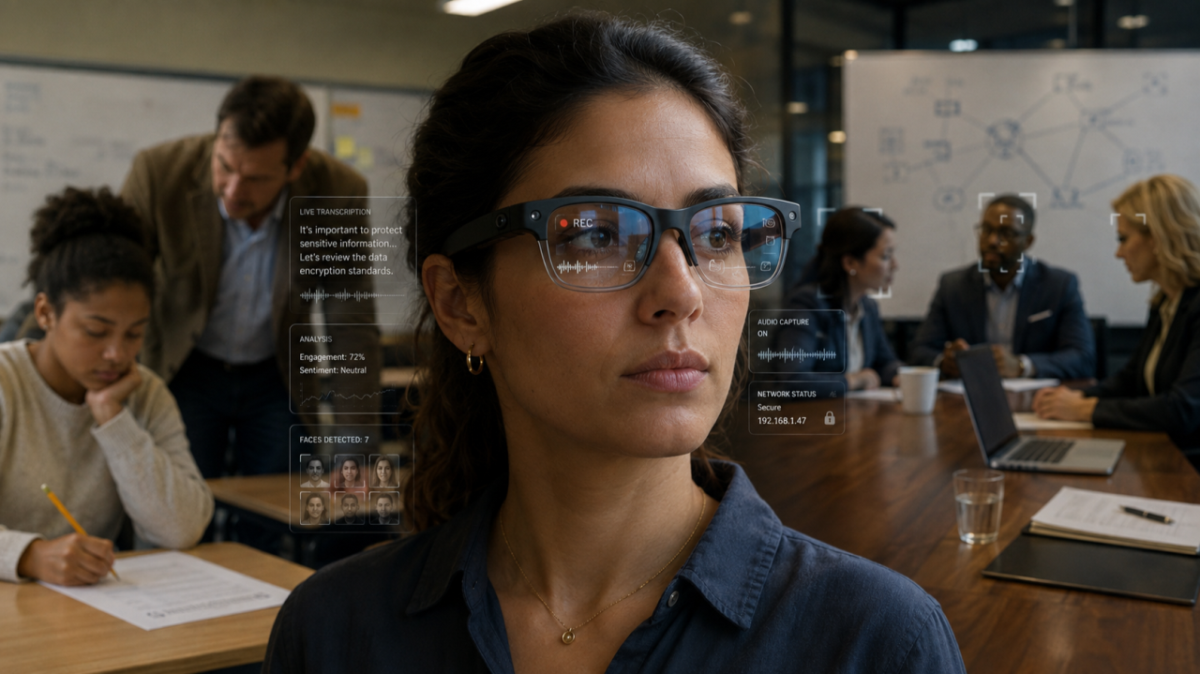
Imagine sitting in a sensitive meeting with someone wearing AI-enabled glasses. Those glasses could potentially contain a camera, microphone, wireless connection, cloud services, and an AI assistant capable of interpreting and transcribing what the wearer sees and hears.

From a security standpoint, that person is no longer simply attending the meeting, but rather they may also be carrying a network-connected collection device on their face. Whiteboards with a network diagram could be captured, an employee badge could be photographed, a sensitive conversation could be recorded, a document sitting on the conference table could potentially be read, an AI system could even summarize or analyze some of that information, or a mix of any of these.

If someone walked into a confidential meeting carrying an obvious camera and microphone connected to the internet, people would probably notice, but put those same capabilities into something that looks like sunglasses and the reaction may be completely different, and that is where the problem starts.

Social Engineering Gets an Upgrade

Smart glasses could also change the way social engineering attacks are carried out. Researchers have already demonstrated experimental systems that combine smart glasses, facial recognition, and publicly available information to identify people and retrieve details about them. Just think about what that could mean for a scammer or cyber attacker.

Someone could potentially approach a target at a conference or other gathering and receive information about that person’s employer, job title, social media presence, or other publicly available details while the conversation is taking place. A bad actor performing physical reconnaissance could discreetly capture badge designs, access control systems, computer screens, or employee behavior. All of that is information that can greatly empower an attacker, as the person attempting an impersonation attack could potentially receive AI-generated suggestions or prompts while they are talking to the victim.

Traditional social engineering has always required preparation. It means the attacker researches the target, learns the story they want to tell, and then tries to remember enough of that information to make the interaction believable. AI-enabled wearables will change that because instead of doing all of the preparation ahead of time, some of it could happen dynamically while the attack is taking place, making it a real-time social engineering copilot.

That should get the attention of anyone responsible for security awareness, dealing with classified information such as PII, PHI, or intellectual property. The physical security challenges will be increased as well.

Why Schools Are Choosing Simple Rules

One thing becomes obvious when looking at the policies schools are creating,  administrators do not want teachers trying to determine whether a particular pair of glasses is recording. That would be nearly impossible to enforce consistently, instead, many policies take the simpler approach. The glasses have to be removed, powered off, or stored during the school day. There is some value in simplicity, however as technology advances, it will be tougher to tell the difference between smart glasses and traditional prescription eyewear.

A complicated policy that requires someone to determine exactly what a device is capable of doing, whether it is currently recording, or which AI features are enabled will probably be very difficult to enforce, and businesses may eventually face the same problem, especially in the hyper-competitive world we live in today.

Organizations will need to decide whether smart eyewear is appropriate in conference rooms, research facilities, manufacturing environments, data centers, hospitals, government facilities, or other places where sensitive information is present. Simply telling employees not to record confidential information may not be enough when recording can happen without anyone else noticing. Eventually, organizations may have to define if they allow wearable cameras and AI assistants at all. This will not be easy.

The Prescription Glasses Problem

Of course, as already mentioned, there is another complication. Smart glasses increasingly support prescription lenses and that means schools and employers cannot necessarily treat them like headphones or smartphones and simply tell everyone to take them off. Some people may legitimately need those glasses in order to see and there are also accessibility cases where AI-assisted eyewear could provide meaningful help to people with disabilities. That means policies will need to separate reasonable accommodation from unrestricted use of recording, communication, or AI features and this is another place where things get messy.

Technology has a habit of moving much faster than policies, and wearable AI is no exception, so organizations need to start thinking through these situations now, before they are dealing with them in the middle of an incident.

The Bigger Lesson

The bigger issue here is not really smart glasses, it is ambient AI. Today, most of us still think about AI as something we intentionally use. We open ChatGPT, we type a prompt, we upload a file, we ask a question, etc. Wearable AI changes that relationship because AI can begin seeing some of the same things we see. It can hear conversations, recognize text, interpret objects, potentially remember interactions, and provide assistance in real time. However, with smart glasses and other small devices like them, the interface begins to disappear into everyday life.

There are some incredible uses for this technology in accessibility, education, translation, navigation, and productivity. Unfortunately, like most useful technologies, there will also be people who figure out how to misuse it. This is not new and we have seen this pattern many times before as technology develops.

The goal should not be to panic about smart glasses or assume that everyone wearing them is doing something malicious, but rather to understand that the risk model has changed. While schools banning smart glasses may seem like a relatively small technology policy story today, it may actually be an early look at a much larger problem organizations of all sizes and across industries are going to face as cameras, microphones, network connections, and AI assistants become smaller, harder to spot, and increasingly difficult to separate from the people using them.

Cybersecurity professionals should be paying attention. For years, organizations have been asking, “Are employees allowed to use AI?” but the next question may be much harder to answer as we have to tackle the question. “What happens when the AI is always watching?”

Categories
Cybersecurity

Cybersecurity’s Next Survival Skill: Learning Faster Than the Threats

Cybersecurity has never been a profession where you can learn something once and expect it to stay relevant forever. Technology evolves, attackers adapt, defenders respond, and then the cycle starts all over again, kind of like a never-ending game of whack-a-mole, except the moles are smarter and are well-funded. What’s changing now is the speed.

Artificial intelligence, autonomous agents, cloud technologies, identity systems, and even quantum computing are moving from research projects and conference presentations into real-world environments. At the same time, attackers are finding new ways to take advantage of every one of those technologies. The result is that cybersecurity professionals aren’t just facing new threats more often, they’re actually facing entirely new ways of thinking about security.

That means our greatest competitive advantage may no longer be what we know today, or what we knew yesterday, I mean how useful is our knowledge of Y2K concerns, it may be how quickly we can learn tomorrow and how quickly we can admit we don’t know something yet without breaking into a cold sweat.

For years, organizations focused on threats that became all too familiar. Phishing, ransomware, malware, credential theft, exposed cloud resources, weak passwords, and systems that somehow remained connected to the internet long after everyone forgot they existed (you know the ones). Those problems haven’t disappeared. If anything, they’re still responsible for a large percentage of successful attacks, sadly they’re now being joined by an entirely new set of challenges.

Artificial intelligence is one of the biggest examples.

Attackers are using AI to create more convincing phishing emails, translate scams into multiple languages, summarize stolen information, generate realistic impersonations, and automate social engineering campaigns that previously required a great deal of manual effort. The old advice about watching for spelling mistakes and poor grammar wasn’t particularly reliable before. Today, it’s practically obsolete. Honestly, your suspicious email might now be better written than your last performance review.

Of course, defenders aren’t sitting still either. Security teams are using AI to help investigate alerts, search logs, write detection rules, summarize incidents, and automate repetitive tasks that consume valuable analyst time. Considering most security teams are already understaffed, overworked, and fueled primarily by caffeine and determination (with a side of mild existential dread), that’s a welcome development.

But AI introduces more than new capabilities, it introduces new risks.

One area that’s beginning to receive a great deal of attention is AI agents. Unlike traditional chatbots that simply answer questions, agents are designed to take action and are goal driven. They may read email, access databases, open support tickets, modify records, execute code, or interact directly with business applications. That makes them incredibly useful, and we will see more and more of this extending the workforce, so what could possibly go wrong?

This new way of allowing AI to function means agents require the same level of governance and oversight that we’d expect for any employee with privileged access, except this employee never sleeps, never takes a vacation, and will happily follow bad instructions at lightning speed. You know how at one time you have given a service account domain admin access just so the damn thing works (we’ve all done it at least once, right? Right?), well that’s a really bad idea here. An AI agent with excessive permissions or poorly defined instructions can make mistakes at machine speed, all while we sleep and blissfully dream of a simpler time.

Prompt injection is a good example of why this matters. Traditional applications have long struggled with malicious input that gets interpreted as commands. AI systems create a similar challenge, except the input isn’t just code, it’s language. A seemingly harmless document, email, webpage, or support ticket could contain instructions specifically designed to manipulate the model into revealing sensitive information, ignoring previous instructions, approving actions, or misusing connected tools.

The challenge isn’t simply protecting software anymore, it’s protecting systems that interpret language, intent, and context, which, if we’re being honest, humans don’t always do perfectly either. If that sounds familiar, it should because social engineers have been exploiting those very things in humans for decades.

Then there’s quantum computing. Sigh.

On a plus note, despite some of the headlines and Hollywood scripts, quantum computers aren’t going to wake up tomorrow morning and instantly break every encryption algorithm protecting the internet. There’s no need to panic, disconnect your network, and begin communicating exclusively through interpretive dance (though that would certainly make incident response meetings more interesting). Having said that, organizations shouldn’t ignore the issue either.

Some of today’s encryption algorithms could eventually become vulnerable to sufficiently powerful quantum computers. Even before that happens, attackers may already be collecting encrypted data today with the expectation that they’ll be able to decrypt it years from now, a strategy commonly referred to as “harvest now, decrypt later” (HNDL, remember that acronym because at some point it will haunt our dreams). That means organizations should begin asking important questions now rather than waiting until migration becomes urgent.

·         Where is encryption being used?

·         Which systems protect sensitive information that needs to remain confidential for years?

·         Are vendors preparing for post-quantum cryptography?

·         Which legacy systems are going to make everyone sigh heavily when it’s finally time to upgrade them?

If you’ve worked in IT  or technology for any length of time, you probably already know the answer to that last question and you’re probably already dreading it.

So where does all of this leave cybersecurity professionals? In many ways, technical knowledge is becoming only part of the equation. The professionals who succeed over the next decade won’t necessarily be the ones who know everything. They’ll be the ones who recognize that nobody can know everything anymore (and stop pretending otherwise). They’ll stay curious, question assumptions, collaborate with others, and remain willing to change their minds when new evidence appears or when the threat landscape makes an unexpected sharp turn in another direction. Think of the Light Cycles in Tron. Yeah, it’s going to be like that sometimes.

Curiosity has always been valuable in cybersecurity, but it’s becoming essential. When a new technology arrives, our first reaction shouldn’t be immediate excitement or immediate skepticism. It should be to understand how it works, what problems it solves, what risks it introduces, and how attackers might eventually misuse it, preferably before someone else does it for us.

Humility is equally important as AI security, cloud security, identity, detection engineering, governance, privacy, application security, and quantum-safe cryptography all evolve rapidly. Nobody is an expert in every one of those areas. The person willing to say, “I don’t know yet, but I’m learning,” often becomes far more valuable than someone confidently repeating advice that was accurate five years ago (and slightly less valuable than someone who also remembers to unmute themselves on calls). In a way, we have all become the dreaded intern who knows nothing about a technology at some point in the last few years.

Learning also isn’t something that should happen in isolation, and security has always (or should have been) been a team sport. The best organizations encourage experienced professionals to mentor newer team members, share lessons learned, explain failures without assigning blame, and create environments where asking questions is viewed as a strength rather than a weakness. Nobody should feel embarrassed by asking how something works, and we should absolutely not shame them for it. We’ve all been the new person at some point, and cybersecurity changes fast enough that we’re all beginners again eventually, whether we like it or not.

Experimentation matters too. Reading about prompt injection attacks or AI agents is helpful. Building a lab and testing them yourself is even better. Organizations should be experimenting with new technologies, validating assumptions, conducting tabletop exercises, evaluating AI permissions, and practicing incident response before they need it. It’s far better to discover weaknesses during a controlled exercise than during an active breach, especially one that starts at 4:57 PM on a Friday, of a 3-day weekend. IYKYK.

Finally, there’s resilience. Cybersecurity can be exhausting, and that’s not going to stop. Every week seems to introduce another framework, another acronym, another product category, or another headline claiming everything has changed forever. Some of those developments genuinely matter. Others are little more than marketing wrapped in technical terminology (with a logo and a webinar series). Part of our job is learning to recognize the difference without becoming cynical or burned out. Our mental health really does matter. Some of us old-timers (and maybe some of the young ones too) have sat quietly sobbing in a corner of a datacenter cage, after being overwhelmed by crap going wrong (hypothetically of course). While a hot pizza delivery and ample amounts of caffeine can help us recover our wits, not being completely mentally exhausted all of the time is far more critical for avoiding that sort of “time out”.

That also means organizations need to rethink how learning fits into the workday. If you are in a leadership role, please pay attention here. Professional development can’t be treated as something employees are expected to squeeze into evenings and weekends after responding to alerts, maintaining certifications, and trying to remember what daylight looks like. Continuous learning needs to become part of the security program itself.

Make time for team discussions, share research, rotate ownership of emerging topics, encourage internal demonstrations, reward thoughtful questions, and absolutely celebrate the person who discovers a weakness before an attacker does. Maybe even buy them coffee while you’re at it.

The technologies shaping cybersecurity will continue to evolve. AI will improve, autonomous agents will become more capable, and quantum computing will continue advancing. New technologies we haven’t even started talking about today will eventually become tomorrow’s security challenge.

Through all of that, one thing will remain constant, cybersecurity has always been about protecting technology, but its long-term success has always depended on people. The organizations that adapt the fastest won’t necessarily have the biggest security budgets or the newest tools., they’ll be the ones that build teams that are curious enough to keep learning, humble enough to keep improving, and willing enough to help each other along the way.

The threats aren’t going to stop evolving and neither can we.